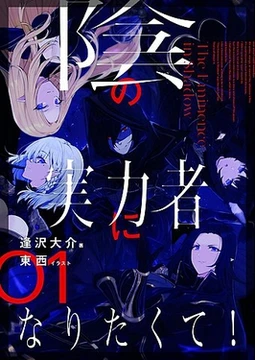
Cid's Shadow
The shadow that casts Cid is not his shadow at all—it is something far older and far hungrier.

Cid's Shadow is the sentient, semi-autonomous entity that manifests as the shadow cast by Cid Kagetsuboshi. To Cid, it appears as a mysterious 'power' or skill he somehow possesses—a dark, shapeless force that obeys his will. In truth, it is a separate being of staggering power with its own personality, desires, and a history that stretches far beyond Cid's understanding. It is one of the most narratively significant elements in The Eminence in Shadow, driving much of the story's central mystery and Cid's self-delusion about his own identity.
The Shadow acts as both weapon and companion: it can separate from Cid's body, strike at enemies with devastating force, and communicate in ways Cid interprets as his own inner voice. Its true nature—tied to the fundamental 'Shadow' force that underpins the world's cosmology—remains a slowly revealed secret that reshapes the reader's understanding of Cid, his 'Cult of the Seven Shadows,' and the balance of power in the world.
- Entity type
- Sentient shadow being / independent entity
- Host / Wielder
- Cid Kagetsuboshi
- Affiliation
- Cid (directly); Shadow Garden (indirectly, via Cid's activities)
- First appears
- Early in the story, during Cid's initial self-discovery
- Status
- Active; bound to Cid but capable of independent action
- Power classification
- Extraordinary—far beyond conventional human or mage capabilities
Lore & Background
In the cosmology of The Eminence in Shadow, 'Shadow' is not merely the absence of light but a fundamental force of existence, a creative and destructive principle woven into the fabric of the world. Cid's Shadow is a manifestation of this force, bound to Cid's body in a way that makes it appear as an ordinary cast shadow until it chooses to act. Its power is not 'magic' in the conventional sense understood by mages, knights, or the various factions of the world; it operates on a level that most characters simply cannot categorize or comprehend.
The Shadow possesses a distinct personality—dry, occasionally sardonic, and fiercely protective of Cid, though it also has its own agenda and sense of purpose. It communicates with Cid in a manner he experiences as his own thoughts or intuition, which feeds directly into his elaborate self-image as a hidden mastermind. The Shadow's true history, its relationship to the broader Shadow force, and the reasons it chose Cid as its vessel are revealed in layers across the story, each revelation deepening the mystery rather than fully resolving it.
Its existence complicates nearly every power dynamic in the world. Factions that measure strength in mana, technique, and lineage have no framework for understanding what Cid's Shadow actually is. When it acts, the results are absolute—enemies are erased, barriers shatter, and the very ground seems to obey its will. This makes it not just a weapon but a narrative force: a reminder that the world Cid (and the reader) thinks they understand is built on assumptions that the Shadow quietly undermines.
In Their Own Story
The corridor of the abandoned cathedral was silent save for the drip of condensation from cracked stone. Cid stood at the center of the nave, his posture relaxed, his expression the bored half-smile he wore when 'enemies' arrived. Three armored figures had sealed the doors. They had not yet sealed their fate.
"You may leave," Cid said, in the flat, rehearsed tone he practiced in the mirror. "Or you may not."
The lead knight laughed. He raised his blade, mana crackling along the edge, and charged.
Cid did not move. He did not need to.
Beneath his feet, the shadow pooled, darkened, and *stretched*—not spreading like ink, but *reaching*, like a hand uncurling after a long sleep. It swept upward through the knight's chest as though he were a sketch on paper and the shadow were an eraser. The armor rang. The knight stopped. The knight looked down. There was a hole in the middle of his torso, clean-edged, as if someone had cut him out of the air.
The other two turned to run. The shadow was already behind them, a long dark smear racing across the floor with a speed that made their legs look like they were moving in slow motion. Two soft thuds. Silence.
Cid exhaled, adjusted his cuffs, and muttered, "…How did I do that? I didn't even think about it."
The shadow pooled back beneath his feet, still, ordinary, unremarkable. If you hadn't just watched it eat three people, you would have sworn it was nothing more than a shadow.
Cid smiled at his reflection in a broken window. "Cult of the Seven Shadows," he whispered. "Phase one: complete."
The shadow, if it could be said to smirk, did.
Reader's Guide
What Cid believes: Cid perceives his Shadow as a 'power' or innate skill—a shadow-manipulation ability he stumbled into after his 'reincarnation.' In his mind, it is a tool he wields, a trick of the light he has learned to command. He narrates its use as his own strategic genius, reinforcing his self-image as a hidden mastermind pulling invisible strings.
What it actually is: The Shadow is a separate, sentient entity with its own will, personality, and long-term purpose. It chose Cid as a host (or anchor) for reasons tied to the world's deeper cosmology. It does not 'obey' Cid so much as it cooperates with him, acting when it deems the situation worthy and retreating when it finds the spectacle amusing.
Mechanics and visible effects: The Shadow can separate from Cid's body, manifest as a three-dimensional dark form, and strike with force that bypasses conventional defenses. It moves with a fluid, almost liquid speed. In combat it appears as a surging mass of darkness that engulfs, cuts, or simply *erases* targets. There is no visible mana aura, no incantation, no build-up—making it nearly impossible for opponents to predict or counter.
Stated limitations: The Shadow's range appears tied to proximity to Cid or to surfaces that can 'hold' shadow. It is not limitless; it conserves itself and does not act on every minor threat. It also seems to require Cid's presence as an anchor—remove him, and its form destabilizes.
Narrative weight: The Shadow is the engine of Cid's delusion. Every act of power he attributes to his own genius is, in truth, the Shadow's doing. This gap between Cid's self-myth and reality is the story's central comedic and dramatic tension, and the Shadow is both the source of it and the key to its eventual unraveling.
Did You Know?
- Cid experiences the Shadow's communication as his own inner thoughts, meaning his 'strategic monologues' and self-aware 'mastermind' narration are partly the Shadow talking through him without him realizing it.
- The Shadow's attacks leave no conventional magical residue, mana trail, or elemental signature—making it nearly impossible for the world's mages or analysts to reverse-engineer or counter it.
- The Shadow's personality is consistently portrayed as dry, slightly condescending, and protective—closer to a sarcastic guardian spirit than a mindless weapon, which complicates Cid's assumption that he is the one in con
- The Shadow's existence directly undermines the power-hierarchy of the world: characters who rank strength by mana output, technique, or lineage have no category for what the Shadow does, creating recurring moments of bew
More in Powers & Artifacts
Elsewhere in the The Eminence in Shadow universe
Spotted an error? Know more?
This is a living reference — every entry is fact-audited, and reader corrections feed straight into our audit queue. Suggest an edit · See this site's audit record