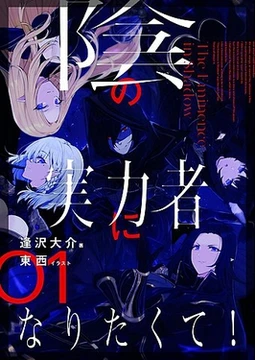
Church Inquisitor
Faith is the blade; the Inquisitor is the hand that never hesitates to swing it.

The Church Inquisitor is a high-ranking agent of the Church, one of the most powerful and politically entrenched factions in the world of The Eminence in Shadow. Serving as both judge and executioner in matters of faith and heresy, the Inquisitor wields extraordinary authority to investigate, try, and eliminate those deemed to threaten the Church's doctrine or the established order.
In the broader narrative, the Inquisitor represents the face of institutional power—rigid, zealous, and operating under a self-appointed moral mandate. Their encounters with the protagonist and his secret organization highlight the tension between a world governed by visible hierarchies and one shaped by the hidden hand of Shadow.
- Role
- Inquisitor / Church agent
- Affiliation
- The Church
- Function
- Hunting heretics, enforcing doctrine, investigating threats
- Status
- Active
Lore & Background
The Church stands as one of the great pillars of civilization in this world, its influence reaching into politics, military affairs, and the daily lives of ordinary citizens. Within this institution, the Inquisitor occupies a position of singular dread: an officer empowered to override local authority, seal evidence, and carry out sentences without the usual bureaucratic delays. Their mandate is framed as the preservation of order and the protection of the faithful from corruption, but in practice it grants them a near-absolute license to act on suspicion alone.
The Inquisitor's methods are a blend of theological rigor and ruthless pragmatism. Interrogations are conducted under the banner of spiritual purification, and the line between righteous judgment and personal vendetta is deliberately blurred. Those who cross the Inquisitor rarely do so by accident—usually they have stumbled upon secrets the Church prefers to keep buried, or they have aligned themselves with factions the institution views as existential threats.
In the wider political landscape, the Inquisitor's actions are often interpreted as the Church's way of projecting strength without directly committing its full military resources. A single Inquisitor's campaign can destabilize a region, silence a rival faction, or redirect public sentiment, all while the Church's upper hierarchy maintains plausible deniability.
In Their Own Story
Rain hammered the cobblestones of the old quarter, turning the lantern light into smeared gold across wet walls. The Inquisitor stood at the threshold of the abandoned chapel, hood drawn low, the silver sigil on their breastplate catching a sliver of moonlight. Behind them, two acolytes waited with bound hands and lowered heads—suspects, heretics, or perhaps simply inconvenient.
"You will speak now," the Inquisitor said, voice flat as a blade laid on a table. "Not because I wish to hear, but because the silence has served its purpose."
They stepped inside. The pews were rotted, the altar cracked, but the Inquisitor's eyes moved past the decay to the symbol scratched into the floor—faint, deliberate, a mark they had tracked across three cities. The acolytes were not the point. The mark was. And whoever had left it would be found, judged, and erased before the next bell tolled.
Outside, the rain continued, indifferent to the weight of the verdict already forming in the Inquisitor's mind.
Reader's Guide
The Church Inquisitor functions as a representative of institutional authority within the story's world. They are not a single fixed personality so much as an archetype of zealous, self-justifying power: convinced of their righteousness, methodical in their pursuit, and utterly unwilling to accept ambiguity. Their role is to embody the Church's reach into the lives of individuals, serving as both a plot device that introduces conflict and a thematic mirror to the hidden, self-appointed justice that Shadow enacts from the shadows.
Personality-wise, the Inquisitor is defined by certainty. Where Cid/Shadow operates through playful, almost theatrical secrecy, the Inquisitor operates through rigid procedure and unyielding conviction. They do not doubt their mandate, and this makes them both formidable and, in the narrative's framing, ultimately brittle.
Key relationships include the broader Church hierarchy that empowers and constrains them, the suspects and heretics they pursue, and—indirectly—the secret organizations that operate outside the Church's jurisdiction. The Inquisitor's signature moments tend to involve public displays of judgment, the sealing of a suspect, or the cold delivery of a sentence framed as mercy.
The gap between perception and reality is central: to the public, the Inquisitor is a guardian of faith. To those they target, they are an executioner wearing a halo. In Cid's eyes, they are another piece of the visible world's machinery—impressive, but ultimately predictable, and therefore not a true threat to one who operates from the space between what is seen and what is hidden.
Did You Know?
- The Church is one of the major established factions in the world, and the Inquisitor role sits at the intersection of theological authority and raw political power.
- The Inquisitor's authority is designed to bypass normal legal channels, making them a tool the Church can deploy without full institutional commitment.
- In the narrative's thematic structure, the Inquisitor serves as a foil to Shadow: both act outside normal accountability, but one does so in the name of public faith while the other does so in secret.
- The Inquisitor's methods—interrogation, public judgment, execution—are framed within the story as acts of spiritual purification, a framing that the narrative invites the reader to question.
More in Characters
Elsewhere in the The Eminence in Shadow universe
Spotted an error? Know more?
This is a living reference — every entry is fact-audited, and reader corrections feed straight into our audit queue. Suggest an edit · See this site's audit record