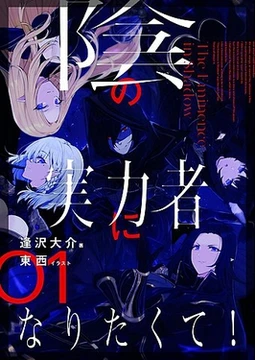
Mercenary Leader
Hired steel, no loyalty—just the next coin that crosses the table.

The Mercenary Leader is a minor, largely unnamed antagonist figure who appears in the broader world of The Eminence in Shadow as the head of a hired-sword company. Rather than a named villain with a personal grudge against Cid Kagenou, this character functions as a representative of the mercenary economy that threads through the world's criminal underbelly—contracted for muscle, information, or intimidation by wealthier patrons who prefer to keep their own hands clean.
In the context of the story, the Mercenary Leader exists to illustrate how the world of The Eminence in Shadow operates beyond the Shadow Garden's orbit: a layered underworld where hired blades, guilds, and criminal syndicates all jockey for influence. The character is not a central figure but a narrative device that grounds the setting in a world where violence is a commodity.
- Role
- Leader of a mercenary company; minor antagonist / world-building figure
- Affiliation
- Independent mercenary group (no fixed faction)
- Status
- Appears as a supporting antagonist in an early-to-mid story arc
- First appears
- Light novel / anime early arcs (exact volume not firmly established in fan consensus)
- Canon prominence
- Minor / background-level character
Lore & Background
In the world of The Eminence in Shadow, mercenary companies occupy a middle stratum of the criminal and quasi-legal economy. They are not as ideologically driven as the various villain organizations Cid (and his Shadow Garden) confront, nor as institutionally powerful as the great guilds and political houses. They are, in essence, professionals: they sell combat capability, intelligence-gathering, and the quiet threat of violence to whoever pays the most.
The Mercenary Leader, as a composite figure of this class, embodies the pragmatic, transactional logic of that world. There is no grand monologue, no personal vendetta against the protagonist. The motivation is economic: contracts, territory, reputation. This makes the character a useful contrast to the more theatrical antagonists Cid encounters, reminding the reader that the world's danger is not solely the product of ambition or malice but also of cold, market-driven self-interest.
Because the character is minor, the canon does not provide extensive backstory. What is established is the functional role: a competent commander of hired fighters, someone who reads a contract, assesses risk, and deploys people accordingly. The Mercenary Leader's presence in the narrative serves to show that Cid's world is populated by ordinary, motivated criminals as well as the extraordinary threats that drive the plot forward.
In Their Own Story
The rain had not stopped for two days when the contract arrived, sealed in wax the color of dried blood. The Mercenary Leader read it once, set it on the scarred oak table, and did not look up at the trembling courier who still stood in the doorway. Behind the leader, a dozen hired swords shifted their weight, boots scraping stone, the soft clink of chainmail the only sound in the low-ceilinged room. "Tell your employer," the leader said, voice flat as a blade laid on a whetstone, "that the rate has doubled. And that I do not repeat myself. The courier left. The leader rolled a single coin across the table, watched it spin, and let it fall to the floor. Somewhere far away, in a shadow no one would ever name, Cid Kagenou was already three steps ahead of the contract that had just been signed.
Reader's Guide
Role in the story: The Mercenary Leader is a functional antagonist, a hired-sword commander who appears to provide a mid-tier combat or intimidation challenge. The character is not a personal nemesis but a representative of the mercenary economy that underpins the world's criminal infrastructure.
Personality: Pragmatic, transactional, and unshowy. Where other antagonists in The Eminence in Shadow are defined by ideology, ego, or obsession, the Mercenary Leader is defined by competence and self-interest. There is no grand speech, no personal grudge—just a ledger of debts and a company to keep solvent.
Key relationships: The Mercenary Leader's primary relationship is with their own company of hired fighters. They are also, functionally, a client to whatever patron hired them, and a potential target for the Shadow Garden if their contract intersects with Cid's current objective.
Signature moments: The character's impact is felt more in the setup and the aftermath than in a single dramatic confrontation. The Mercenary Leader's scenes are typically brief, efficient, and grounded in the logistics of hiring, deploying, and extracting a mercenary force.
The Cid gap: Cid, operating under his Shadow persona, perceives every opposition through the lens of a grand, theatrical villainy. A mercenary leader, by contrast, is boring by those standards—no philosophy, no monologue. This mismatch is itself a small comic and tonal beat: Cid's internal monologue over-analyzes a purely economic actor, while the Mercenary Leader simply wants to collect payment and go home.
First appearance: Early-to-mid arcs of the light novel and anime. The character does not undergo major development because the narrative does not require it; they are a world-building anchor rather than a character arc.
Did You Know?
- The Mercenary Leader is a composite, minor figure rather than a named, recurring character, which means their exact identity can vary slightly between light novel, anime, and manga adaptations.
- The mercenary economy they represent is one of the few 'ordinary' criminal structures in a world otherwise dominated by superhuman individuals and shadow organizations, making them a grounding element in the setting.
- In The Eminence in Shadow, Cid's tendency to over-interpret every opponent as a grand villain makes even a purely transactional mercenary leader feel, in his mind, like a piece of a larger conspiracy—highlighting the gap
- The character's brevity in the narrative mirrors a broader pattern in the series: the world is far larger and more mundane than Cid's shadow-obsessed perspective allows, and minor figures like the Mercenary Leader are re
More in Characters
Elsewhere in the The Eminence in Shadow universe
Spotted an error? Know more?
This is a living reference — every entry is fact-audited, and reader corrections feed straight into our audit queue. Suggest an edit · See this site's audit record