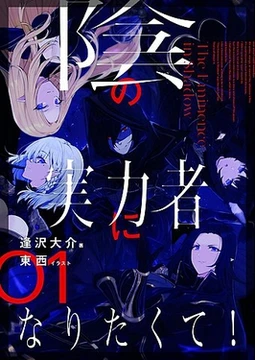
The Shadow Court
Nine blades in the dark, one name they all answer to: Shadow.

The Shadow Court is the shadowy, all-encompassing authority that Cid Kagetsuboshi—known to the world only as "Shadow"—wields over his secret organization, Shadow Garden. Rather than a single spell or relic, it functions as a living institution: a hidden hierarchy of elite operatives who answer to one enigmatic master and move through the world's darkest corners to dismantle evil before it can take root. To the public, the Shadow Court is a myth whispered in taverns and feared in court halls. To its members, it is the only name that matters.
In the broader cosmology of the series, the Shadow Court represents the principle that true protection operates from darkness, not from the spotlight. Its power is not a single artifact but the accumulated will, skill, and loyalty of those who pledge themselves to Shadow's cause, making it simultaneously an organization, a philosophy, and a force that reshapes the political and magical landscape of the world.
- Type
- Secret Organization / Collective Authority
- Leader
- Shadow (Cid Kagetsuboshi)
- Affiliation
- Shadow Garden (independent)
- Purpose
- Protection of the world from hidden and overt evil
- Known Members
- Nine operatives (Alpha through Iota)
- Status
- Active
Lore & Background
The Shadow Court was born not from a grand prophecy but from a single man's desperate, half-delusional conviction that the world needed a hidden hand. Cid, convinced he had been reborn into a world of magic and monsters, assembled a cadre of individuals he believed to be his "shadow subordinates." In truth, each member—Alpha, Beta, Gamma, Delta, Epsilon, Zeta, Eta, Theta, and Iota—was already a figure of extraordinary power in their own right, drawn to Shadow by a combination of genuine admiration, personal vendettas, and the magnetic gravity of a man who spoke with absolute certainty about a future he could not actually see.
The Court's doctrine is simple in principle and devastating in execution: identify the threat, eliminate it, and vanish before the world can name you. There is no banner, no throne room, no public address. The Shadow Court exists in the negative space between events—in the assassinations that never make the morning broadsheets, in the conspiracies that dissolve before they can cohere, in the quiet moments where a would-be tyrant simply ceases to be a problem. Its members operate as a single organism, each covering the others' blind spots, each a different facet of the same shadow.
What makes the Shadow Court narratively singular is its duality. To the world, it is a terrifying, almost supernatural force. To Cid, it is the validation of his self-image as the mysterious, all-knowing Shadow. The gap between those two perceptions is where the story's comedy and its genuine emotional weight both live. The Court is real, its members are real, the threats they face are real—but the man at its center is perpetually one step ahead of his own understanding of what he has actually built.
In Their Own Story
The candle had guttered out an hour ago, but the room still smelled of beeswax and iron. Cid stood at the window, watching the rain stitch the city into a single grey thread, and felt the familiar hum of nine minds attuned to his will. Not literally, of course. They were scattered across three districts, two rooftops, and one very expensive tavern on the east side, each waiting for a word. A single word. That was the architecture of it. One word, and the Shadow Court would fold the world's problems into a shape he could hold.
Alpha's voice came through the quiet like a blade being drawn from its sheath. "The merchant's seal is broken. The cargo is not what it claims."
Cid exhaled. Somewhere in the back of his mind, the part that remembered a fluorescent office and a lukewarm coffee, he wondered if this was what it felt like to be a god. The part that remembered the rain, the cold, the ache in his shoulders, said no. It felt like being responsible. It felt like nine people trusting a man who had, three days ago, almost been caught in a very embarrassing misunderstanding with a noblewoman's handmaiden.
"Shadow," Beta said, and the title landed in the room like a stone in still water. "We are ready."
He turned from the window. The rain kept falling. The Court waited. And Cid, the Shadow, the man in the dark, spoke the single word that would set nine blades in motion across the city. The word was, of course, something completely ordinary. But in the mouths of the Shadow Court, ordinary words carried the weight of the world.
Reader's Guide
The Shadow Court is not a spell, a weapon, or a single magical artifact. It is a structure of authority and collective capability: the hidden organization through which Shadow (Cid) projects his will onto the world. Its "power" is the sum of nine extraordinarily skilled operatives acting in concert under one command, backed by Cid's strategic (if often delusional) direction.
Mechanics and deployment: In combat or covert operations, the Court functions as a layered system. Alpha handles intelligence and reconnaissance. Beta, Gamma, and Delta serve as direct combat and enforcement. Epsilon, Zeta, Eta, Theta, and Iota cover support, logistics, and specialized roles. They coordinate through pre-arranged signals and a shared understanding of Shadow's intent, allowing them to act simultaneously across multiple fronts without a central battlefield.
Visible effects: To outside observers, the Shadow Court manifests as a series of impossible coincidences—enemies defeated before they can act, conspiracies unraveling, powerful figures vanishing. There is no visible aura, no magical signature. The "effect" is the absence of a threat, which is harder to perceive than any explosion.
Limitations: The Court is only as effective as its leader's judgment, and Cid's judgment is frequently clouded by his delusion that he is in a fantasy world with a shadow-broker role. He overthinks, misreads social cues, and occasionally issues orders based on a misunderstanding. The members must interpret his words through the lens of his "persona," which adds a layer of friction. The Court also has no public legitimacy; it cannot hold territory, govern, or sustain itself through open means.
What Cid believes vs. reality: Cid is convinced the Shadow Court is his secret weapon in a world of monsters and magic, that he is the mysterious mastermind guiding nine elite agents. In reality, the members are independently powerful individuals who chose to follow him, the world's threats are largely human in origin, and much of the Court's success comes from the members' own competence rather than Cid's direction. His "strategic genius" is often just a very confident guess that happens to land correctly because the situation was never as complex as he imagined.
Narrative weight: The Shadow Court is the emotional and structural spine of the series. It is where Cid's loneliness, his need for purpose, and his genuine (if misdirected) desire to protect others find their expression. Every arc that involves the Court is, at its core, a story about trust: nine people trusting a man who doesn't fully understand the world he's in, and one man trusting nine people who see more clearly than he does.
Did You Know?
- The Shadow Court's nine members are each individually powerful enough to be considered among the most dangerous figures in the world, yet they all defer to a man whose primary superpower is an unshakable sense of self-im
- Cid's delusion that he is a 'shadow broker' in a fantasy world means he frequently misidentifies mundane social situations as epic confrontations, and the Court must quietly adapt to his misreadings without breaking the
- The organization has no physical headquarters that functions as a traditional 'court' or throne room; its authority is entirely relational, existing in the bonds between Shadow and his subordinates rather than in any bui
- Despite operating in total secrecy, the Shadow Court's influence is so pervasive in the series' world that multiple factions, governments, and magical orders actively try to identify, recruit, or eliminate it—treating it
More in Powers & Artifacts
Elsewhere in the The Eminence in Shadow universe
Spotted an error? Know more?
This is a living reference — every entry is fact-audited, and reader corrections feed straight into our audit queue. Suggest an edit · See this site's audit record