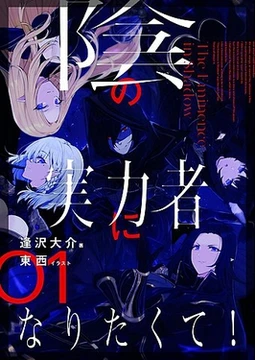
Ciel's Father
A nobleman whose shadow lingers in the past of the Shadow Garden's most devoted blade.

Ciel's Father is a minor, largely off-screen figure from The Eminence in Shadow, known primarily through the backstory of Ciel, one of the seven members of the Shadow Garden. He belonged to the upper echelons of the noble class and is referenced in the context of the family circumstances that ultimately led Ciel to her life as a shadow operative under Cid Kamishiro (the self-proclaimed Eminence in Shadow).
He does not appear as a recurring or named antagonist in the main narrative. His significance to the story lies entirely in shaping Ciel's past, her motivations, and the emotional weight she carries into her role within the Shadow Garden. For readers and viewers, he functions as a narrative anchor explaining how a noblewoman became one of the most lethal and devoted members of Cid's secret organization.
- Role
- Background / backstory figure (Ciel's father)
- Affiliation
- Noble house (Ciel's family)
- First appears
- Referenced in Ciel's backstory (light novel / manga)
- Status
- Not a recurring character; referenced in past-tense exposition
- Known for
- Being the nobleman whose family circumstances shaped Ciel's path to the Shadow Garden
Lore & Background
In the world of The Eminence in Shadow, the noble class wields enormous political and social power, and the lives of those born into its ranks are shaped by duty, alliance, and the cold calculus of family reputation. Ciel's Father occupied a position within this hierarchy, and the specific dynamics of his household—its alliances, its pressures, its internal conflicts—form the backdrop against which Ciel's early life unfolded. The story treats his era as a closed chapter: a world of gilded halls and whispered politics that Ciel has since left behind, replaced by the clandestine operations of the Shadow Garden.
What the narrative emphasizes is not his personal ambitions or political machinations, but the effect his family's circumstances had on Ciel. The weight of expectation, the constraints of noble obligation, and the sense of being shaped by forces larger than one's own will are recurring themes in how Ciel's past is presented. Her father represents that world in miniature: a man whose status defined his daughter's possibilities before she ever chose her own path.
Because he is a backstory figure rather than an active participant, the story offers the reader a deliberately limited portrait. He is a name, a title, a memory that Ciel carries. The emotional resonance of his existence comes not from dialogue or action, but from the gap between the life he could have offered and the life Ciel ultimately forged for herself among the shadows.
In Their Own Story
The candlelight in the study had long since guttered out, leaving only the blue glow of a distant window. Ciel sat at the edge of the old writing desk, her fingers tracing the grain of the wood as though reading a letter she would never send. The room smelled of cold ash and something faintly floral—rosewater, perhaps, a habit from a house she had not entered in years. She did not think of him as a man. She thought of the weight of a seal pressed into wax, the particular creak of the third stair on the east wing, the way the household had gone quiet in the weeks before everything changed. She set her fingers down. The Shadow Garden had work to do, and the past was a door she had already locked. But some nights the lock felt thinner than it should.
Reader's Guide
Ciel's Father functions as a narrative device rather than a character in the traditional sense. His role is to ground Ciel's backstory in the concrete world of the noble class, giving the reader a tangible origin for a woman who otherwise exists almost entirely in the present tense of the Shadow Garden's operations. He is referenced in past-tense exposition, and the story never places him in a scene of active conflict or dialogue.
Personality and specific traits are left largely to implication. What the narrative conveys is the atmosphere of his household: the pressure of noble expectation, the sense of a life predetermined by lineage. Ciel's relationship to him is one of inherited obligation and, ultimately, departure. She does not speak of him with overt hatred or longing; the tone is one of quiet finality, a door closed.
Key relationships are limited: he is Ciel's father, and through her, tangentially connected to the Shadow Garden. He has no known interaction with Cid, Ciel's fellow Garden members, or the broader cast. His significance is entirely relational and retrospective.
There is no major character development for him, as he does not appear in the present timeline. His "arc" is the arc of Ciel's: the moment she left his world behind and stepped into the shadows. First referenced in the early volumes where Ciel's backstory is established, he recedes into the background and is not revisited as a plot element.
Did You Know?
- Ciel's Father is never shown on-screen or in a dedicated scene; he exists entirely through Ciel's backstory exposition and the reader's inference.
- His noble status is what makes Ciel's transition into the Shadow Garden so narratively significant: she moved from the most visible rung of society to its most concealed corner.
- In the broader story, Ciel's devotion to Cid and the Shadow Garden is often read by fans as a conscious rejection of the life her family's world represented, making her father a symbol of the path she chose not to walk.
- Despite being a background figure, he is one of the few characters in the series whose entire narrative purpose is to explain another character's present, a structural choice the light novel employs for several Garden me
More in Characters
Elsewhere in the The Eminence in Shadow universe
Spotted an error? Know more?
This is a living reference — every entry is fact-audited, and reader corrections feed straight into our audit queue. Suggest an edit · See this site's audit record