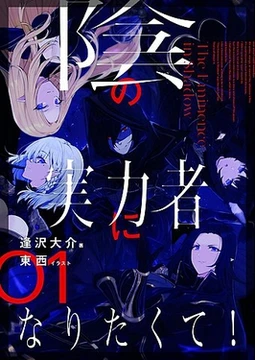
Royal Family Heir
The crown's future bearer, blissfully ignorant of the Crimson Demon who polishes their hallways.

The Royal Family Heir is the designated successor to the throne of the kingdom in which Cid Kamishiro serves in his public, low-ranking capacity. This character occupies the uppermost rung of the court's social hierarchy and represents the political authority that Cid's 'knight' persona must navigate daily—often with the kind of oblivious deference that his inner Shadow monologue finds absurd.
In the broader narrative, the heir functions as a linchpin of the kingdom's internal politics, connecting the royal court to the wider web of noble houses, military orders, and the shadowy forces Cid believes (incorrectly, from his perspective) are part of some grand 'isekai' plot. Their decisions ripple outward, creating the very political turbulence that Cid misreads as evidence of his deluded worldview.
- Role
- Heir to the royal throne
- Affiliation
- Royal Family / Kingdom Court
- Setting
- The main kingdom where Cid holds a low-ranking court position
- Relationship to Cid
- Cid serves in a minor court capacity beneath them; they are largely unaware of his true identity as Shadow
- Status
- Active political figure in the kingdom's governance
Lore & Background
In the kingdom's political structure, the heir sits at the intersection of every faction: the old noble houses who resent the crown's centralizing power, the military commanders who answer to the throne, and the bureaucratic machinery of the court. The heir's position is therefore never purely ceremonial; every audience, every decree, every marriage negotiation carries weight that Cid—buried in his menial duties—watches from the periphery with the detached amusement of a man who thinks he's observing a 'villain arc' in a fantasy novel.
What makes the heir's role particularly rich in the narrative is the dramatic irony. Cid, in his Shadow persona, views the kingdom's politics as the 'real world' of a story he's been reincarnated into. He assigns motivations, 'plot roles,' and 'character arcs' to the royal family with the confidence of a self-appointed narrator. The heir, meanwhile, is simply a person making difficult choices under pressure, navigating loyalty, duty, and personal desire. The gap between Cid's grandiose internal commentary and the heir's grounded, human complexity is a recurring source of both comedy and genuine tension.
The heir's arc also intersects with the larger threats to the kingdom—military conflicts, internal conspiracies, and the very existence of the Shadow Garden as a hidden force. Whether the heir learns of Shadow's existence, or whether their political decisions inadvertently create the openings Cid exploits, remains a thread that ties the 'court drama' layer of the story to the 'secret organization' layer without fully merging them.
In Their Own Story
The corridor smelled of beeswax and old stone. Cid—no, *Shadow*, though the thought felt like a sneeze he couldn't finish—kneeled with a polishing cloth in his hands, watching the heir's procession pass three paces above him. The heir paused. Not for him. For the fountain. They pressed a thumb against the marble lip, feeling for a crack, and their expression shifted from the practiced serenity of the throne room to something smaller, more tired. Cid's inner monologue roared: *Ah, the 'reluctant ruler' arc, Chapter Seven of the Royal Volume, the protagonist's weight of the crown—* The heir looked down. Not at Cid. At his hands. The red stains under the fingernails. A beat. Then the heir walked on, and the corridor swallowed the sound of their footsteps. Cid exhaled. *...That was definitely a foreshadowing beat.* He was not, in fact, in a novel. He was in a hallway, with a stain on his sleeve, and the heir was three floors up, probably deciding whether to sign a trade treaty or nap. Both felt, to Cid, like plot armor.
Reader's Guide
The Royal Family Heir functions as the political anchor of the kingdom's 'surface' storyline. Their role is to embody the weight of governance: succession pressure, noble intrigue, military obligation, and the slow erosion of personal identity under the crown. Personality-wise, the heir is written as composed but not cold—someone who performs duty with a quiet, almost weary grace, and whose private moments (a pressed thumb on a fountain's edge, a long stare out a window) reveal the person beneath the title.
Key relationships center on the court: advisors who pull them in competing directions, military figures who demand decisive action, and the lower-ranking courtiers—like Cid—who are invisible to them until they are not. The heir does not know Cid is Shadow. To them, he is a minor functionary with a stain on his sleeve. To Cid, they are a 'major NPC in the kingdom's political subplot.' This asymmetry is the core of their dynamic.
Signature moments tend to be quiet rather than explosive: a decision made in silence, a look held a beat too long, a decree that shifts the kingdom's balance without a single raised voice. Cid narrates these as 'plot developments.' The heir experiences them as Tuesday.
First appearance is in the early volumes, within the first few chapters, as part of Cid's introduction to the court setting. Their development tracks the kingdom's escalating political and military crises, gradually shifting from a figure of ceremonial authority to one making choices with real, irreversible consequences.
Did You Know?
- Cid's internal Shadow monologue routinely assigns the heir a 'character role' in his imagined isekai narrative, often misreading simple court decisions as evidence of a hidden master plan.
- The heir's interactions with Cid in his public 'knight/servant' capacity are almost entirely one-directional—the heir rarely registers his presence, which Cid interprets as 'NPC indifference.'
- The political decisions the heir makes in the court storyline create the very conditions (war, instability, power vacuums) that Cid's Shadow Garden exploits, without either side knowing the other exists.
- The gap between how Cid narrates the heir ('the reluctant ruler arc!') and how the heir actually behaves (tired, practical, human) is one of the series' most consistent sources of comedic and dramatic irony.
More in Characters
Elsewhere in the The Eminence in Shadow universe
Spotted an error? Know more?
This is a living reference — every entry is fact-audited, and reader corrections feed straight into our audit queue. Suggest an edit · See this site's audit record