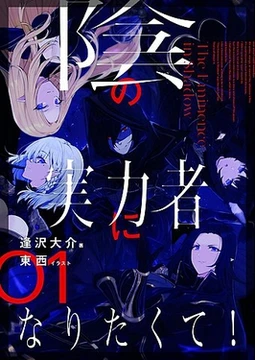
Royal Knight
The blade a kingdom sharpens to defend its throne, and the oath that makes it bleed.

The Royal Knight is a title and position of considerable prestige within the hierarchical military and political structures of the kingdoms that populate the world of The Eminence in Shadow. Rather than a single fixed individual, the designation marks the apex of a kingdom's knightly order—a warrior who serves as the sovereign's ultimate blade and shield, embodying the martial honor and loyalty that define the realm's identity on the stage of a world where supernatural power and political intrigue collide.
In the broader narrative, figures bearing this title occupy a fascinating middle ground: they are powerful enough to command respect from shadow operatives, mages, and foreign powers, yet they operate within the rigid frameworks of courtly duty and national obligation. This makes them both formidable and tragically constrained, a tension that the story of the Shadow Garden frequently exploits and subverts.
- Role
- Supreme knightly title within a kingdom's military hierarchy
- Affiliation
- Sovereign kingdom (court and military)
- Status
- Active title (held by a designated knight of the realm)
- Power tier
- Elite warrior, rivaling or exceeding typical supernatural combatants
Lore & Background
In a world where individuals can channel supernatural force, command elemental phenomena, or wield ancient artifacts, the Royal Knight represents the pinnacle of a nation's martial tradition. The title is not merely honorific; it carries with it sweeping authority over the kingdom's standing forces, the right to act in the sovereign's name during the monarch's absence, and a personal obligation to defend the realm's borders, its people, and its ancient laws. The selection of a Royal Knight is a matter of national significance, often involving trials of strength, loyalty, and strategic acumen that test candidates against the full spectrum of threats the world presents.
The position carries a weight that is as much psychological as it is political. A Royal Knight's word is law on the battlefield; their refusal to act is a crisis of state. This makes the role both the kingdom's greatest asset and its most vulnerable point—a single act of betrayal, a single moment of hesitation, can unravel years of diplomatic and military standing. The narrative of The Eminence in Shadow frequently places such figures in opposition to the Shadow Garden's covert operations, creating a natural friction between the open, oath-bound honor of a kingdom's champion and the shadowy, amoral pragmatism of Cid Kagemune's organization.
What makes the Royal Knight compelling to readers is the duality inherent in the role: the outward radiance of a hero who rides at the head of a charge, versus the inward solitude of a person bound by duty to a throne that may not even know their name. The story treats such figures with a respect that acknowledges their genuine sacrifice, even as the Shadow Garden's operations render their carefully maintained order irrelevant in the larger game of power.
In Their Own Story
The torches along the processional road had burned down to embers by the time the Royal Knight dismounted. The ceremonial armor, polished to a mirror sheen for the coronation, had grown cold against the skin beneath. Around the great hall, lords and ladies still murmured their congratulations, their toasts still warm with wine and ambition, but the Knight stood apart near the vaulted entrance, one hand resting on the pommel of a sword that had not yet tasted blood for this reign.
A messenger's hawk circled overhead, its shadow sweeping the marble floor in slow arcs. The Knight watched it with the patience of someone who had learned that every message, no matter how urgent, could wait until the oath was spoken. Behind them, the throne hall glittered with the accumulated gold of a kingdom that believed, with every coin it spent, that its walls would hold forever.
The Knight exhaled. The air tasted of wax and old stone. Somewhere beyond the city's outer ramparts, the wind was shifting, carrying the faint metallic tang of a storm that no court astronomer had yet named. They turned back toward the hall, toward the voices, toward the weight of a crown they had not earned but would defend.
The hawk circled once more, then dove toward the western gate. The Knight's hand tightened on the sword. Not yet. Not yet.
Reader's Guide
Role in the story: The Royal Knight functions as a symbol of structured, oath-bound power in a world that the Shadow Garden operates outside of. They represent the 'open' face of authority—legitimate, visible, accountable—against which Cid's hidden, self-mythologizing operations are measured. Encounters between the two sides tend to highlight the gap between institutional power and individual, unbound capability.
Personality: Figures holding this title are typically defined by a deep internalized sense of duty, personal honor, and a willingness to place the collective good above individual desire. They are not villains; they are people who have chosen a path of service and carry the loneliness that choice entails. Their confidence is earned through years of training and sacrifice, not arrogance.
Key relationships: Their bond with the sovereign is the defining relationship of the role—mutual, sacred, and politically binding. They also maintain ties to the broader knightly order, to the kingdom's military, and, in the narrative, to the Shadow Garden as an opposing or intersecting force.
Signature moments: The coronation oath, the first battle in the new reign, and any confrontation with the Shadow Garden's operatives serve as the title's dramatic peaks. The gap between Cid's perception (a rigid, predictable enemy of the 'order' he mocks) and the Knight's reality (a person who genuinely loves their people and would die for them) is the emotional core.
First appearance: The title and its holder appear in the early-to-mid volumes as the narrative establishes the political landscape of the kingdoms. Major character development comes as the Knight is forced to confront the inadequacy of their kingdom's defenses against threats that operate outside the rules they were trained to respect.
The Royal Knight is best understood not as a plot device but as a mirror: the story holds them up against the Shadow Garden's chaos to ask whether structure or freedom is the truer form of strength.
Did You Know?
- The Royal Knight's authority is tied to the sovereign's will, meaning the title's power is as much political as martial—a knight without a king is merely a very strong person.
- In the world of The Eminence in Shadow, the Royal Knight operates in the 'light' of public duty, making them a natural narrative foil to Cid Kagemune, who thrives in the 'shadow' of hidden influence.
- The selection and oath-taking of a Royal Knight is treated as a national event, carrying diplomatic weight that can shift alliances between kingdoms.
- The title's emphasis on personal honor and public accountability creates a tragic vulnerability: a single act of perceived betrayal can destroy not just the Knight's career but the kingdom's standing.
More in Characters
Elsewhere in the The Eminence in Shadow universe
Spotted an error? Know more?
This is a living reference — every entry is fact-audited, and reader corrections feed straight into our audit queue. Suggest an edit · See this site's audit record