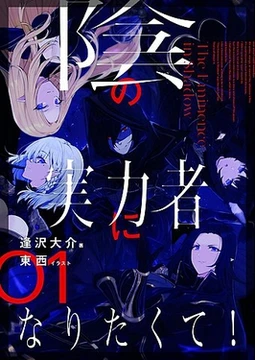
The Shadow Organization
A secret society built on one man's imagination—and the world's luckiest accident.

The Shadow Organization is the secret society that Cid Kagenou (operating under the codename 'Shadow') founded after his inexplicable transmigration into another world. In his mind, it is a clandestine force dedicated to hunting down the 'Seven Sins'—seven great sinister lords who threaten the world. In practice, it is a rotating cast of extraordinarily powerful individuals who gather in a hidden mansion, listen to Cid's theatrical monologues, and go along with his plans in a mixture of confusion, amusement, and genuine loyalty.
The organization is the central comedic and narrative engine of the series. Its 'strategy meetings' are less about tactical planning and more about Cid performing elaborate shadow-puppetry while his members exchange bewildered glances. Yet beneath the farce, the Shadow Organization functions as the story's moral center: a group of genuinely capable people who, for whatever reason, have chosen to follow a man they can never quite figure out.
- Leader (codename)
- Shadow (Cid Kagenou)
- Member designations
- Greek-letter codenames (Alpha through Omega)
- Stated mission
- Eliminate the Seven Sins (Seven Great Sinister Lords)
- Base of operations
- Shadow Garden (a concealed estate)
- First appears
- Opening chapters of the light novel / manga / anime
- Status
- Active and ongoing
Lore & Background
The Shadow Organization was born from a very specific kind of loneliness. Cid Kagenou, a young man who had spent his previous life obsessively consuming dark-fantasy media, found himself in a world of magic and monsters with no one to share his grandiose vision with. Rather than simply survive, he *role-played*. He invented the Seven Sins, the codenames, the dramatic entrance poses, the whispered 'I am the darkness that devours all light.' He built an entire mythology around himself and then, through a chain of coincidences that the narrative treats as both absurd and inevitable, he actually recruited members.
The members are not pawns. Alpha (Sigma) is a woman of royal standing in Ascrus with combat prowess that dwarfs most nations' armies. Beta, Gamma, Delta, and the rest each carry their own histories, grudges, and power levels that would make them legends in any other context. Yet they all orbit Cid's gravitational pull, whether from genuine admiration, a debt they cannot repay, or the simple fact that arguing with a man who casually reshapes reality is exhausting. Their loyalty is real even if their understanding of what they're fighting for is, at best, fuzzy.
The organization's true 'lore' is a palimpsest: Cid's elaborate fiction layered over the world's actual political and supernatural threats. The Seven Sins, as Cid describes them, are largely a product of his dramatic imagination. The world does have genuine antagonists, ancient evils, and political machinations—but the specific 'Seven Sins' Cid monologues about at the dinner table are his own creation. The comedy and the heart both live in that gap: the gap between the man who thinks he's a shadowy mastermind and the man who is, in fact, the most powerful being on the continent and simply doesn't register it as significant.
In Their Own Story
The chandelier in the Shadow Garden's great hall was made of a material that shouldn't have existed in this world, and it hummed faintly, like a tuning fork struck against the fabric of reality. Cid stood at the head of the long table, his coat billowing in a draft from no visible source. He raised one finger.
'Tonight,' he whispered, and the room went still, 'we speak of the Third Sin.'
Across the table, Alpha set down her teacup with the careful precision of a woman who had, three minutes ago, single-handedly dismantled a siege engine. Beside her, Beta and Gamma exchanged a look that said, in full, *What is the Third Sin? Did he make that up again? Should I pretend I know?*
Cid did not notice. Cid never noticed. He was already composing his next line, fingers splayed, eyes half-lidded, the chandelier's hum swelling to something almost musical. The candles flickered in sympathy—though they were simply reacting to the thermal displacement of a man who, without meaning to, had just rewritten the local mana density.
'You are the shadow,' Cid said, to no one, to everyone, to the concept of opposition itself. 'And the shadow does not ask permission to fall.'
Alpha took a long sip of tea. '...Shall I pass the bread, Shadow?'
'...Yes. Thank you, Alpha.'
And the meeting continued. It always continued. The bread was always passed. The Third Sin was never, in the end, quite as specific as Cid implied. But the candles kept flickering, and the chandelier kept humming, and no one in the room—least of all the man at the head of the table—had any idea how close they were to being, in the literal sense, the most important organization in the world.
Reader's Guide
The Shadow Organization is not a 'power' in the mechanical sense; it is a social structure, a narrative framework, and—because Cid is the man he is—a force field of unintended consequences. Its 'mechanics' are as follows:
Cid convenes meetings at Shadow Garden, a hidden estate whose defenses are, to put it mildly, overkill. He presents 'intelligence' on the Seven Sins, assigns codenames, and issues directives. The members, each individually capable of toppling small nations, listen with varying degrees of patience. The visible effect of a 'Shadow directive' is usually Cid monologuing for twenty minutes while the members quietly eat dessert.
In combat, the organization's deployment is... informal. Cid does not 'command' battles in any tactical sense. He walks into a situation, delivers a dramatic line, and then proceeds to overwhelm the threat so completely that the concept of 'strategy' becomes irrelevant. The members handle their own engagements with their own methods. The organization's 'coordination' is Cid saying something like 'We move as one shadow' and then everyone going in separate directions and winning anyway.
The critical distinction: Cid believes he is the hidden hand pulling strings, the mastermind whose plans are so layered that even his own members can't see the full picture. In reality, his 'plans' are a man improvising a role-play scenario in real time, and the world is bending around him because he is, objectively, the most powerful person in the setting. The Seven Sins he fights are largely his own invention. The 'threats' he averts are often resolved by the members acting on their own initiative while Cid is still composing his entrance line. The organization's narrative weight is not in its power—it is in the fact that a group of extraordinary people chose to believe in a story one person told, and that story, by virtue of being believed, became real.
Did You Know?
- The 'Seven Sins' that the organization is ostensibly fighting are, in large part, Cid's own dramatic invention. The world has real antagonists, but the specific 'Seven Great Sinister Lords' he monologues about at dinner
- Every member of the organization is individually powerful enough to be a national-level threat. The organization's 'strength' is not a sum of parts; each part alone exceeds the whole as Cid imagines it.
- Cid's base, Shadow Garden, is protected by defensive mechanisms that are, by the world's standards, essentially apocalyptic. He built them as part of his 'shadow organization' aesthetic and never realized how absurdly ov
- The members' codenames follow the Greek alphabet (Alpha, Beta, Gamma, etc.), a naming convention Cid chose because it felt 'cool and mysterious' in the dark-fantasy media he consumed in his previous life.
More in Powers & Artifacts
Elsewhere in the The Eminence in Shadow universe
Spotted an error? Know more?
This is a living reference — every entry is fact-audited, and reader corrections feed straight into our audit queue. Suggest an edit · See this site's audit record