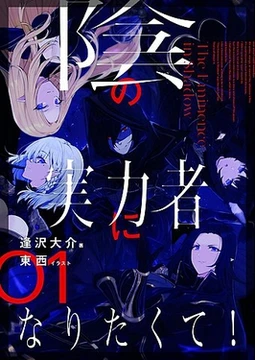
The Shadow Court's Second Move
He thought he was the shadow; the shadow was everyone else, and he just got the credit.

The Shadow Court's Second Move is a fan-coined designation for the early arc of The Eminence in Shadow in which Cid Kagenou, operating under his self-assumed identity as the enigmatic leader "Shadow," executes what he believes is his organization's second grand operation. In reality, the events unfold through a cascade of coincidences, his subordinates' independent agency, and Cid's spectacularly delusional self-narration.
The arc is a cornerstone of the series' comedic engine: Cid scripts an elaborate shadowy masterplan in his head, while the actual outcomes are driven by the competence of his Seven Shadows, the meddling of rival factions, and the sheer absurdity of a man who cannot distinguish between his own actions and the world simply happening around him. It cements the tone that defines the franchise—high-concept fantasy action filtered through an unreliable, deeply self-deluded protagonist.
- Protagonist
- Cid Kagenou (self-styled "Shadow")
- Organization
- Shadow Garden (Kage no Niwa)
- Tone
- Comedy / Action / Unreliable narration
- Setting
- A magic-bearing fantasy world with guilds, demons, and political intrigue
- Narrative device
- Cid's delusional first-person hero fantasy layered over third-person reality
- Status
- Early-series arc establishing the core comedic premise
Lore & Background
In the world of The Eminence in Shadow, power is stratified through magic, martial skill, and political affiliation. Guilds, noble houses, and secret societies all vie for influence, and the line between hero and villain is often a matter of perspective. Into this world walks Cid Kagenou, a man who, upon reincarnation, decided that the most fulfilling life is one lived as a mythic, unseen force—pulling strings from the dark while the world cheers for a name it cannot see.
His "Shadow Garden" is, in his mind, a clandestine network of elite operatives carrying out his will. In practice, it is a small group of extraordinary individuals—Alpha, Beta, Gamma, and the rest of the Seven Shadows—each with their own agendas, loyalties, and capabilities that far exceed Cid's. They respect him, protect him, and execute operations with surgical precision, all while Cid sits in his "shadowy lair" (a modest apartment) narrating his own legend.
The Second Move arc crystallizes this dynamic: Cid devises a plan he believes is cunning and invisible, while the actual resolution comes from his subordinates acting on their own initiative, a rival faction's internal conflict, and a chain of events so improbable that Cid simply files it under "my genius at work." The lore of the Shadow Garden thus becomes a living joke—a secret organization that is, to its members, a genuine refuge and purpose, and to its "leader," a stage for his one-man theater.
In Their Own Story
The lamp flickered. Cid pressed his back against the cold wall of the back room, watching the two men in the alley argue over a ledger. In his mind, he was already three moves ahead—already the whisper in their ear, the hand on the ledger, the shadow that made them flinch.
"They're terrified," he murmured to the empty room.
Across the city, in a room he would never see, Alpha set down her teacup, glanced at the ledger's true owner, and made a phone call. Beta was already en route. Gamma had been watching since dawn. None of them had been told. None of them needed to be.
Cid straightened an invisible collar, exhaled slowly, and whispered, "The board is set. Now… we wait in the dark."
He did not wait in the dark. He waited on his couch, eating snacks, narrating his own legend to a potted plant. The plant, naturally, did not respond. But in the story he was telling himself, it had bowed.
Reader's Guide
The arc opens with Cid, freshly settled into his role as the self-appointed head of the Shadow Garden, devising what he calls his second major operation. He frames it as a covert strike against a local power player, complete with coded language, a "shadowy" infiltration plan, and a dramatic internal monologue about the weight of being unseen.
In reality, the target's troubles are being addressed by his subordinates acting independently. Alpha handles the political angle, Beta deals with the physical threat, and the rest of the Seven Shadows cover angles Cid never even considered. Cid, meanwhile, is in his apartment "planning" and "observing" (watching a news broadcast).
The climax arrives as a convergence: the target's enemies are neutralized, the political threat dissolves, and Cid is publicly (or semi-publicly) credited for a move he did not make. He accepts the credit with grave, shadowy dignity. The subordinates smile, say nothing, and go back to their own lives.
Key characters: Cid, Alpha, Beta, Gamma (and references to the wider Seven Shadows). Major revelation: the gap between Cid's self-image and his actual agency is not a flaw the story corrects—it is the engine. The arc advances the broader story by establishing the Shadow Garden as a functioning entity independent of Cid, setting up the escalating misunderstandings that will define the series.
Adaptation note: The manga and light novel present these beats with slightly different pacing; the anime adaptation compresses some internal-monologue scenes into visual gags. The core comedic structure—Cid's narration vs. the subordinates' competence—remains consistent across all media.
Did You Know?
- The organization Cid calls the 'Shadow Garden' is, in the Japanese original, 'Kage no Niwa'—literally 'Shadow Garden'—a term that evokes a hidden, cultivated space rather than a military court, which is part of the comed
- Cid's delusion is never 'corrected' by other characters in the early arcs; his subordinates actively enable and protect his self-narration, treating it as a form of respect or endearment rather than a misunderstanding to
- The Seven Shadows each possess distinct specializations (combat, intelligence, support, etc.), and their competence is consistently portrayed as exceeding anything Cid could realistically contribute, a contrast the serie
- The series' core narrative structure—first-person delusional narration intercut with third-person reality—mirrors the format of a 'hero's journey' told by someone who is not actually the hero, subverting the trope the pr
More in Arcs & Volumes
Elsewhere in the The Eminence in Shadow universe
Spotted an error? Know more?
This is a living reference — every entry is fact-audited, and reader corrections feed straight into our audit queue. Suggest an edit · See this site's audit record