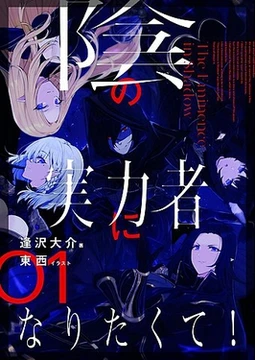
Delta's Awakening
The quiet blade remembers what the world tried to bury.

Delta's Awakening is a pivotal arc in The Eminence in Shadow (Kage no Jitsuryokusha ni Naritakute!) that peels back the layers of one of Shadow Garden's most enigmatic members. While Cid Kagenou—delusional mastermind 'Shadow'—narrates the events as yet another brilliant stroke of his hidden plan, the arc genuinely centers on Delta's buried past, loyalties, and the identity they have kept locked away from their fellow operatives. It is the moment the organization's quiet, disciplined second-in-command stops being a supporting silhouette and becomes the emotional heart of the story.
The arc functions as a turning point for Shadow Garden's internal dynamics and for the broader web of organizations—Cult of Diablos, the Church, and the ancient powers lurking beneath the surface—that Cid has (in his mind) been maneuvering all along. For the reader, it is a rare instance where the 'villain-of-the-week' framing dissolves and a genuine character study takes the stage.
- Focal Character
- Delta
- Affiliation
- Shadow Garden
- Organization Leader
- Cid Kagenou (as 'Shadow')
- First Appears
- Early in the series, during Shadow Garden's introduction
- Status
- Active operative
- Thematic Role
- Identity, loyalty, and the cost of a hidden past
Lore & Background
Within the world of The Eminence in Shadow, Shadow Garden operates as a clandestine organization of elite operatives, each assigned a Greek-letter designation. Delta occupies a position of quiet authority—second to none in discipline, yet perpetually in the background of Cid's grandiose, self-aggrandizing monologues. Their combat style is precise, economical, and lethal, a stark contrast to the flashy, over-the-top theatrics Cid attributes to his own 'shadow techniques.'
The Awakening arc draws out Delta's history: a past entangled with the Cult of Diablos and the larger machinations of the world's hidden powers. What was once a clean, operational loyalty to Shadow becomes complicated when old wounds reopen and Delta is forced to confront who they were before they became a letter of the alphabet in Cid's roster. The arc interrogates a central question of the series—whether the people in Cid's orbit are truly his 'subordinates' or independent individuals who simply tolerate his delusions because the alternative is worse.
Thematically, Delta's Awakening mirrors the series' broader comedy-of-errors structure: Cid is convinced he engineered every revelation, every emotional beat, every tactical shift, when in reality Delta's choices are entirely their own. The gap between Cid's narration and the reader's understanding of what actually happened is the engine of the series' humor, and this arc pushes that gap to its widest, most tender point.
In Their Own Story
The rain had not stopped for three days. Delta stood at the edge of the ruined chapel, the stone steps slick beneath their boots, and watched the smoke curl upward from the Cult's shattered sanctuary. Somewhere below, Gamma was already counting bodies. Epsilon was already filing the report in that flat, mechanical voice that made Cid call it 'the sound of justice being typed.'
Delta did not move. They pressed a hand against the broken altar, feeling the cold seep through the leather of their glove, and for a moment the letter on their collar—DELTA—felt less like a designation and more like a cage. The name they had before the Garden. The face they had before the mask. The person who had stood in this very chapel, years ago, and sworn an oath to something they could no longer remember the name of.
A voice crackled through the comm unit. 'Delta. You are behind schedule. I have already prepared a seventeen-point debrief and a motivational speech. Please hurry. The shadows do not wait for the slow.'
Delta almost smiled. Almost. Then they turned, pulled the hood low, and walked back into the grey. Behind them, the chapel groaned and settled, and something in the rubble shifted—something that had been waiting, patient as stone, for someone to finally come back and look.
Reader's Guide
The arc opens with a routine Shadow Garden operation that goes sideways when Delta encounters a surviving member of the Cult of Diablos. What should be a simple elimination becomes a confrontation with a past Delta has spent years burying. Cid, watching from his 'shadow throne' (a very ordinary apartment), immediately reinterprets the entire incident as a master plan he devised weeks ago, complete with a monologue about 'the chessboard of the dark.'
Key characters involved include Delta, Cid (narrating), Gamma and Epsilon as supporting operatives, and a Cult of Diablos survivor who serves as the catalyst. The major revelation is Delta's true history and the identity they have concealed from their fellow Garden members, which reframes their loyalty and their combat philosophy.
For Cid's delusional hero's journey, the arc is a triumph: he credits himself with 'awakening' Delta, with 'planning' the confrontation, and with 'guiding' their emotional resolution. In reality, Delta's choices are entirely autonomous, and Cid's contributions are limited to being in the vicinity and talking loudly.
The arc connects to the broader story by deepening the Cult of Diablos thread, reinforcing Shadow Garden's internal bonds, and setting up future confrontations with the series' larger antagonistic forces. It also establishes a pattern—Cid misattributes agency, the reader sees the truth, and the comedy compounds.
Adaptation note: The light novel treatment gives Delta's internal monologue significantly more weight than the anime adaptation, which relies more on visual storytelling and Cid's deadpan narration. Fans of the prose version will find the emotional beats land harder on the page.
Did You Know?
- Delta's Greek-letter designation is part of Shadow Garden's naming convention, where each operative is identified by a letter rather than a name—a system Cid claims he 'invented from the shadows' but which is, in fact, a
- Cid's narration during the arc repeatedly refers to Delta's emotional breakthrough as 'Phase Three of my awakening protocol,' a plan he did not write, did not execute, and did not anticipate.
- The arc's setting—a ruined chapel—echoes locations from the Cult of Diablos storyline, creating a visual callback that rewards readers who have been tracking the series' recurring locations.
- Delta's combat style in this arc is notably different from earlier appearances: fewer acrobatic flourishes, more grounded and deliberate strikes, reflecting the emotional weight of confronting their past rather than perf
More in Arcs & Volumes
Elsewhere in the The Eminence in Shadow universe
Spotted an error? Know more?
This is a living reference — every entry is fact-audited, and reader corrections feed straight into our audit queue. Suggest an edit · See this site's audit record