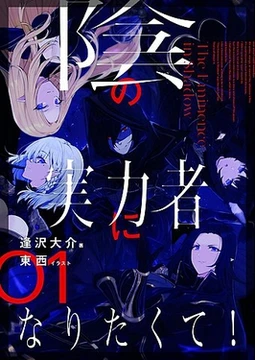
The School
Where the world's greatest shadow mastermind is, in fact, just a guy late for homeroom.

The School is the modern-world educational institution where Cid Kagyuu (known in his delusional inner world as 'Shadow') attends as an ordinary student. It is the primary stage for the series' signature comedic engine: the gulf between Cid's grandiose internal monologue—where every hallway is a covert operations corridor and every classmate is a loyal operative of his self-invented 'Shadow Garden'—and the perfectly mundane reality of group projects, lunch breaks, and pop quizzes.
Set in the same world as the fantasy continent of Ashenvale, the school represents the 'surface life' Cid maintains. His friends here are genuine, warm people who know nothing of his shadowy persona, and the school's ordinary rhythms provide the emotional grounding that makes his absurd delusions both hilarious and, in quieter moments, a little sad.
- Type
- Secondary school (modern world)
- World
- Coexists with the fantasy continent of Ashenvale
- Cid's role
- Student / self-appointed 'mastermind' in his own mind
- Narrative function
- Comedic contrast; 'normal life' anchor
- Key dynamic
- Cid's delusional framing vs. the friends' genuine, unremarkable interactions
Lore & Background
In the layered cosmology of The Eminence in Shadow, a modern human world sits alongside the sword-and-sorcery realm of Ashenvale. The School belongs to the former. It is a perfectly unremarkable institution—bright corridors, chalk dust, the smell of cafeteria curry—yet to Cid it is the most dangerous operational theatre in existence. In his head, every interaction is a carefully staged recruitment, every group assignment a covert briefing, every teacher a suspicious informant. The reader, of course, sees only a slightly eccentric teenager who narrates his life like a noir thriller.
The school is where Cid's friendships are forged in genuine, low-stakes moments: sharing snacks, complaining about homework, the quiet solidarity of being stuck in the same seat for a year. These bonds are real to him and to them, even though he mentally files them under 'Shadow Garden operatives' in his private ledger. The comedy is relentless, but the underlying truth is that Cid, for all his theatrical self-mythology, is simply a young person trying to be liked and to belong.
The school also serves as the narrative's pressure valve. After the high-stakes fantasy arcs in Ashenvale, the story returns to the classroom, and the tonal whiplash is part of the series' identity. The audience gets to breathe, laugh, and remember that the 'Eminence in Shadow' is, in the most literal sense, a kid who still has to turn in his math worksheet.
In Their Own Story
The bell rings. Cid slouches into the back row, backpack half-off one shoulder, and mutters to himself: 'Phase three of the infiltration is complete. The target—no, the *classmate*—has not yet detected my true identity.' He drops into his seat with a thud that makes the girl two rows ahead glance back and say, 'Cid, you're blocking the whiteboard.' He blinks. '…Apologies, operative.' She tilts her head. '…What?' He smiles, perfectly ordinary. 'Nothing. Pass me the eraser?' She does. Outside the window, the cherry blossoms drift in a slow pink spiral, and for one unremarkable second, no one is a shadow mastermind. They are just two students, and the afternoon is warm, and the world is small and bright and enough.
Reader's Guide
The School is a conventional modern secondary school: a multi-storey building with tiled corridors, sliding classroom doors, and a central courtyard where students gather at break. The layout is functional—classrooms on the upper floors, a cafeteria and administrative offices on the ground level, and a small library tucked near the stairwell. There is nothing architecturally remarkable about it, which is precisely the point; it is the anti-Ashenvale, a space of fluorescent lights and printed worksheets.
Narratively, the school is the site of Cid's most sustained delusional performance. In his mind, the corridor is a 'secure transit route,' the cafeteria is a 'liaison briefing hall,' and the courtyard is a 'tactical staging ground.' In reality, it is where he gets his lunch tray knocked over, where he argues with a friend about who gets the window seat, and where he quietly, genuinely laughs. The contrast is the entire engine of the setting.
Characters most tied to the school are Cid and his close group of classmates, who interact as a friend group over the course of the term. Their relationships are built on small, repeated moments rather than grand events. The school's in-universe lore is essentially non-existent from the characters' perspective—it is simply where they go every day. All the 'lore' is Cid's private, elaborate mythology layered over the ordinary, and the reader's pleasure comes from watching that mythology collide with a teacher saying, 'Sit down, everyone, we have a test.'
Did You Know?
- The School is set in the same world as the fantasy continent of Ashenvale; the two settings coexist rather than being separate dimensions.
- Cid's 'Shadow Garden' organization, as he perceives it from the school, is entirely a product of his own imagination—his classmates have no idea he considers them operatives.
- The school arcs function as a tonal reset after the high-fantasy sequences, giving the story a comedic and emotional breathing room that is central to the series' identity.
- Despite Cid narrating every school interaction as a covert operation, his friendships there are portrayed as genuinely warm and reciprocal, making the delusion both funnier and more poignant.
More in World & Setting
Elsewhere in the The Eminence in Shadow universe
Spotted an error? Know more?
This is a living reference — every entry is fact-audited, and reader corrections feed straight into our audit queue. Suggest an edit · See this site's audit record