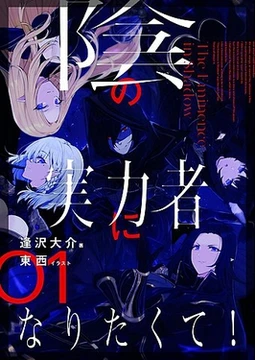
The Shadow Realm
A man who built a legend in the dark, and the world that believed him before he could stop it.

The Shadow Realm is not a single plotted location on a map so much as the conceptual and narrative domain at the beating heart of The Eminence in Shadow. It is the liminal space where Cid's self-constructed identity as the enigmatic, all-powerful 'Shadow' takes shape, where the secret organization Shadow Garden conducts its operations, and where the series' signature comedy—a delusional man whose delusion accidentally becomes reality—collides with genuine magical and political consequence.
For the reader, the Shadow Realm functions as the lens through which every event is refracted: what Cid believes is his shadowy masterstroke is, in the grounded reality, a coincidence, a misunderstanding, or a genuine act of heroism that no one attributes to him. This dual-layered space is the engine of the entire story, making every chapter a small act of dramatic irony played out in the gap between myth and man.
- Concept type
- Thematic / narrative domain (not a single physical location)
- Central figure
- Cid (as 'Shadow')
- Primary organization
- Shadow Garden
- First appears
- Volume 1 (light novel)
- Narrative role
- Core engine of dramatic irony and identity
- Status
- Ongoing, evolving across all published volumes
Lore & Background
In the world of The Eminence in Shadow, power is stratified by magical aptitude, political faction, and the quiet, invisible influence of those who operate outside the spotlight. The 'Shadow' occupies a unique position in this hierarchy: a name whispered in intelligence briefings, a ghost in the records of Shadow Garden, a figure whose face no one has confirmed. Cid, a young man with no particular talent for magic, stumbles into this world and, rather than correcting the misunderstanding, leans into it with the full theatrical commitment of someone who has always wanted to be the cool, brooding protagonist of a story.
Shadow Garden, the organization that anchors the Shadow Realm, is a real, operational secret society with members who possess genuine power and agency. The irony that defines the series is that these members—Curtain, Delta, Gamma, Epsilon, Zeta, Beta, and Alpha—genuinely revere 'Shadow' as a legendary figure, and Cid's improvised, over-the-top monologues and 'strategic' postures are interpreted as evidence of his genius. The Shadow Realm, then, is the space where this feedback loop sustains itself: Cid performs the shadow, the world rewards the performance, and the performance becomes indistinguishable from the thing itself.
Thematically, the Shadow Realm interrogates the relationship between identity and perception. Cid is not a hero in the traditional sense; he is a spectator who became the main character through sheer narrative will. The realm he inhabits is therefore never fully stable—it shifts between the grand, dramatic framing he imposes on events and the mundane, chaotic reality the reader sees. This tension is the soul of the series and what makes the Shadow Realm more than a setting: it is a question asked in every chapter.
In Their Own Story
The rain had just stopped when Cid stepped out of the alley, his coat still damp, his expression carefully calibrated to 'I was here all along but you only now noticed.' Across the street, a woman in a Shadow Garden insignia was already running toward him, eyes wide, breathless. 'Shadow-sama, the eastern depot—how did you know they'd move the crates at midnight? It was… it was exactly as you predicted.' Cid let a beat of silence stretch. He had not predicted anything. He had been reading a novel in the park and happened to glance at the street. He tilted his head, let a single strand of hair fall across his forehead, and said, 'The shadows always speak to me.' The woman's eyes glistened. Behind her, Delta was already scribbling in a ledger, and somewhere in the building, Curtain was quietly updating the file. The file that said, and would always say: *Shadow. Origin: unknown. Power: unknown. Status: indispensable.* Cid walked on, hands in his pockets, feeling the particular warmth of being a mystery he had invented himself.
Reader's Guide
The Shadow Realm is best understood as a layered space rather than a single address. At its most concrete, it is the physical territory of Shadow Garden's operations: the safehouses, the intelligence rooms where members like Curtain and Delta track threats, and the streets of the city where Cid's 'shadow missions' unfold. These locations are ordinary by the world's standards—stone buildings, narrow lanes, market squares—but they are saturated with the narrative weight of the 'Shadow' legend that Cid projects onto them.
A second layer is the conceptual domain of the Shadow identity itself. When Cid enters a room and delivers a monologue, the 'Shadow Realm' expands to include every listener's perception. Members of Shadow Garden experience this as a revelation of hidden genius; the reader experiences it as a man who watched too many isekai novels. The same event, two realities, one realm.
A third layer is the political and magical world that exists independently of Cid: the factions, the magical systems, the genuine threats that Shadow Garden is staffed to handle. This layer is where the story's stakes are real, and where Cid's accidental competence (or the competence of people who genuinely believe in him) produces outcomes that ripple outward. The Shadow Realm, in this sense, is the intersection of all three layers—the place where a delusion, a real organization, and a real world overlap and create something none of them could alone.
Characters most tied to this space include Cid (the projector), the Shadow Garden members (the believers), and the broader cast whose lives are quietly reshaped by 'Shadow's' interventions. The realm shifts constantly: in Cid's head it is a dark throne room of brooding power; in the reader's eye it is a young man in a coat, slightly out of breath, hoping no one checks the alibi.
Did You Know?
- The entire premise hinges on a feedback loop: Cid's delusional self-image is interpreted by genuinely powerful people as evidence of a legendary figure, and his improvised reactions are read as masterful strategy.
- Shadow Garden's members operate independently and possess real agency and power; the organization is not a figment of Cid's imagination, which is what makes the misunderstanding so structurally stable.
- The series is a deliberate, self-aware parody of the 'hidden overpowered protagonist' isekai trope, yet it commits fully to the world's internal logic, making the comedy land alongside genuine action and character drama.
- Cid's 'shadow' persona is never officially confirmed or denied by any in-universe authority, leaving the Shadow Realm permanently in a state of narrative limbo that the story never resolves.
More in World & Setting
Elsewhere in the The Eminence in Shadow universe
Spotted an error? Know more?
This is a living reference — every entry is fact-audited, and reader corrections feed straight into our audit queue. Suggest an edit · See this site's audit record