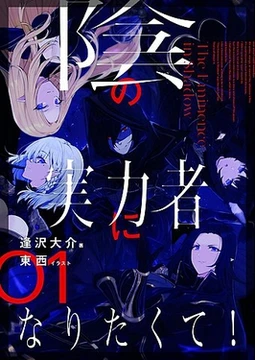
The Empire
Where the altar and the throne share a single crown of iron and incense.

The Holy Empire is one of the great sovereign powers in the world of The Eminence in Shadow, a theocratic state in which religious authority and imperial governance are fused into a single ruling structure. Headed by a Holy Emperor, it commands vast military resources, a layered nobility, and a pervasive church that shapes law, culture, and daily life across its territories. It stands as a separate nation from the Kingdom where Cid Kamishiro's school is located, and its political machinations form a significant backdrop against which the story's larger conflicts unfold.
While Cid's direct adventures are anchored in the Kingdom, the Empire's interests, alliances, and rivalries ripple outward, touching trade routes, magical research, and the balance of power that the Shadow Court's (albeit self-styled) covert operations inadvertently influence. For fans, the Empire represents the 'real world' of high politics and institutional power that contrasts with the schoolyard heroics and Cid's elaborate self-mythology.
- Type
- Theocratic Empire / Major Sovereign Power
- Ruler
- Holy Emperor
- Political Structure
- Imperial monarchy intertwined with a state church
- Relation to the Kingdom
- Separate sovereign nation
- Role in the World
- One of the dominant political and military powers
- Status
- Active major power throughout the story
Lore & Background
The Holy Empire's identity is built on the inseparability of faith and state. Its capital is a city of grand temples, administrative halls, and garrisoned walls, where the Holy Emperor presides over both spiritual and temporal matters. Nobles owe allegiance not merely to a crown but to a sacred mandate, and the church's clerics hold seats of genuine political influence. This fusion creates a society that is simultaneously devout and ruthless, where heresy is treason and treason is a sin against the divine order.
In the broader world of the series, the Empire coexists with the Kingdom and other nations in a fragile equilibrium of trade, diplomacy, and occasional armed tension. Its military is well-organized, its nobility is stratified by lineage and martial prestige, and its capital serves as a hub where envoys, merchants, and magical scholars converge. The Empire's internal politics—succession questions, noble rivalries, and the church's own ambitions—provide a rich tapestry of intrigue that runs parallel to the more personal, school-centered drama in the Kingdom.
For the reader, the Empire often functions as the 'bigger picture': the institutional weight of history, law, and collective belief that individual heroes and shadowy organizations must navigate or disrupt. It is the world that exists whether or not a single student decides to play the ultimate shadow master, and its continued stability (or collapse) is a quiet undercurrent beneath the story's more explosive set-pieces.
In Their Own Story
The evening bell tolls across the capital's white-stone spires, and the incense from the Grand Temple drifts down into the market squares where merchants are packing their stalls. A low-ranking noble's daughter walks the processional road, her family's crest—a silver wheat sheaf—embroidered on her cloak, and she does not look up at the palace. She has learned, as all children in the Empire learn, that the Holy Emperor's gaze is everywhere, even in the silence between prayers. Three streets over, a military courier seals a dispatch with red wax and slides it into a satchel. The message is short: grain shipments from the southern provinces are delayed. The courier does not know that this single line of logistics will, by week's end, become a talking point in a noble's dinner, a footnote in a church council's minutes, and a quiet concern in the mind of a foreign ambassador who has not yet decided which side of the border he truly serves. The Empire turns. It always turns. And in the Kingdom, a certain student is already asleep in his dormitory, dreaming of a shadow organization that does not exist, entirely unaware that the grain he ate for breakfast was grown in imperial soil.
Reader's Guide
Purpose: The Holy Empire exists to maintain theocratic order—governing its people under the combined authority of the Holy Emperor and the state church. Its stated mission is the preservation of divine law, territorial integrity, and the spiritual welfare of its citizens.
Hierarchy: At the apex sits the Holy Emperor, whose authority is both political and sacred. Below the throne, a layered nobility manages provinces, military districts, and administrative functions. The church hierarchy operates in parallel, with high clerics holding advisory and judicial roles. Military commanders and bureaucratic officials fill the operational ranks.
Key members: The Holy Emperor is the central figure. Various noble houses, military leaders, and senior clergy populate the ranks, though the series focuses more on the Kingdom's cast, so Empire figures often appear as background powers, envoys, or political context rather than recurring protagonists.
Plot function: The Empire serves as the macro-political backdrop. Its policies, alliances, and internal tensions shape the world's balance of power and create the conditions under which the Kingdom's events—and Cid's shadowy (self-perceived) operations—carry broader significance.
Interactions: The Empire trades, negotiates, and occasionally postures militarily against the Kingdom and other nations. Its relationship with the Kingdom is one of mutual awareness and cautious respect, with both powers aware that the other's internal stability affects regional security. The Shadow Court's (Cid's imagined) global influence is, in his mind, felt even in imperial corridors, though in reality the Empire's concerns are far more mundane than a single student's delusions of grandeur suggest.
Did You Know?
- The Holy Empire is a theocratic state, meaning its government and religious institution are structurally intertwined rather than separate, making the Holy Emperor both a political and spiritual sovereign.
- The Empire is a distinct sovereign nation separate from the Kingdom where Cid's school is set, meaning the two operate as independent political entities with their own laws, militaries, and diplomatic relations.
- The Empire's political and military weight provides the 'bigger world' context for the story, contrasting the school-centered personal drama with the institutional gravity of an entire theocratic state.
- Cid's elaborate Shadow Court mythology positions him as a global power broker, yet the Empire's actual concerns—trade, succession, clerical politics—proceed largely independent of his (nonexistent) covert operations, hig
More in Factions & Groups
Elsewhere in the The Eminence in Shadow universe
Spotted an error? Know more?
This is a living reference — every entry is fact-audited, and reader corrections feed straight into our audit queue. Suggest an edit · See this site's audit record