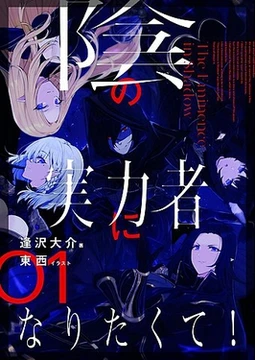
The Seven Sins
Seven living sins that sit above every throne and every blade in the known world.

The Seven Sins are the seven apex individuals who sit at the absolute pinnacle of the dark hierarchy in The Eminence in Shadow. Each one embodies a sin and wields power that dwarfs every other faction on the continent, making them the ultimate antagonists that the self-proclaimed 'Shadow' Cid sets out to topple. They are not merely a council; they are the living embodiment of the world's deepest corruption, each a force of nature in their own right.
Their existence defines the upper limit of what the story's power system can produce. While the Shadow Court and the various national powers clash in the mid-tiers of strength, the Seven Sins operate in a stratosphere where a single gesture can reshape landscapes. They are the final wall between Cid's grandiose ambitions and the 'true' ending he envisions for himself.
- Type
- Antagonist faction (apex tier)
- Member count
- Seven
- Affiliation
- Top tier of the Cult of Diablos
- Role in story
- Primary antagonists / final-tier bosses
- Power ceiling
- Transcends all other factions and individuals
- Status
- Active throughout the series
Lore & Background
In the layered power structure of The Eminence in Shadow's world, the Cult of Diablos functions as the overarching shadow organization, and the Seven Sins are its seven crowning figures. They are not merely generals or lieutenants; they are the organization's reason for existing. Each Sin commands a domain of influence and a personal power so vast that even the strongest heroes of the various nations would be annihilated in an instant. Their very presence in a region bends the ambient magic and will of lesser beings, creating an aura of dread that lower-ranking cult members interpret as divine authority.
What makes the Seven Sins terrifying is not just their raw strength but their unity of purpose. They do not bicker or scheme against one another the way lesser power blocs do. They operate as a single will with seven faces, each Sin covering a different aspect of the world's corruption. This makes them nearly impossible to isolate or turn against one another, a stark contrast to the more politically fractured groups that populate the mid-level conflicts of the story.
Their relationship to the broader world is one of quiet, absolute dominion. They do not need to conquer cities or raise armies in the conventional sense. Their influence seeps through the Cult of Diablos' lower ranks, through corrupted magic, and through the slow erosion of free will in those who come too close. By the time a nation realizes it is under their thumb, the damage is already irreversible. This makes them a fundamentally different kind of threat from the more overt military conflicts that drive the earlier arcs.
In Their Own Story
The hall had no doors. That was the first thing any visitor noticed, though 'visitor' was too generous a word for the wretched souls who stumbled in. The air tasted of iron and old blood, and the light came from nowhere and everywhere, casting no shadows because the light itself was a kind of hunger. Seven thrones sat in a loose semicircle, and in each one sat a figure so still it was hard to tell if they breathed. The one in the center did not look up. It did not need to. It already knew the name of the person standing at the far end of the hall, the name of their mother, the name of the god they prayed to as a child, and the exact moment they would stop existing. "You are early," it said, and the voice was not a sound but a pressure behind the eyes. The person at the far end of the hall, who had walked through three armies to get here, found that their knees had begun to bend. Not from fear. From the simple, inescapable fact that the floor beneath them had decided, in this room, that gravity was a suggestion the Seven Sins could revoke.
Reader's Guide
The Seven Sins exist as the ultimate antagonistic tier in The Eminence in Shadow. Their stated purpose is the domination and reshaping of the world according to the will of the Cult of Diablos, though in practice each Sin pursues a different facet of that goal—corruption of magic, subjugation of nations, the unraveling of free will, and the annihilation of those who stand in the way. They are the ceiling of the story's power system.
Their internal hierarchy is rigid and absolute. There is a clear order among the seven, and the topmost Sin holds authority over the others in matters of strategy, though each retains full autonomy in their own domain. They do not delegate; they do not negotiate among themselves. Decisions are made and executed as a single directive.
In the plot, the Seven Sins function as the long-horizon threat. While the mid-level conflicts involve the Shadow Court's operations, national politics, and the Cult of Diablos' lower operatives, the Seven Sins represent the endgame. Cid/Shadow's entire grand narrative is oriented around eventually confronting them, and the story's pacing is structured so that the reader understands the gap between the current power level and the Seven Sins' tier.
Their interactions with other groups are defined by asymmetry. The Shadow Court, the various national armies, and even other magical factions are, from the Seven Sins' perspective, insects. They do not engage with these groups directly unless absolutely necessary. Instead, they work through the Cult of Diablos' lower hierarchy, letting lesser operatives do the dirty work while they remain in a state of near-total seclusion, preserving their power for the moments that truly matter.
The key narrative tension they create is one of scale: the reader is constantly reminded that the characters they have grown to love are, in the grand scheme, still far below the true apex of power, and that the final confrontation will require something beyond what has been shown so far.
Did You Know?
- The Seven Sins are not a loosely affiliated group but a single, unified hierarchy—there is no internal politics, no rivalry, no betrayal among them, which makes them fundamentally different from the more factional mid-le
- Their power is so far above the rest of the cast that the story's mid-level conflicts, while dramatic to the characters involved, are essentially irrelevant to the Seven Sins, who operate on a different plane of influenc
- Cid/Shadow's entire self-mythologized narrative as 'the Eminence in Shadow' is, in part, oriented around the fantasy of defeating beings like the Seven Sins, making them the narrative justification for his grandiose self
- The Seven Sins do not need to fight to win. Their mere presence in a region is enough to warp the magical environment and subjugate the wills of lesser beings, meaning a direct confrontation is actually the least likely
More in Factions & Groups
Elsewhere in the The Eminence in Shadow universe
Spotted an error? Know more?
This is a living reference — every entry is fact-audited, and reader corrections feed straight into our audit queue. Suggest an edit · See this site's audit record